
Audi A2 e-tron drivetrain
The Audi A2 e-tron uses the MEB+ platform with rear-mounted APP350 and APP550 motors, LFP and NMC batteries, up to 183 kW DC charging and bidirectional V2L and V2H.
The A2 e-tron is built on the Volkswagen Group’s MEB+ platform, the updated version of the architecture underneath the Volkswagen ID.3 and Cupra Born. Every version is rear-wheel drive with a single motor on the rear axle — there is no quattro variant in the launch range.
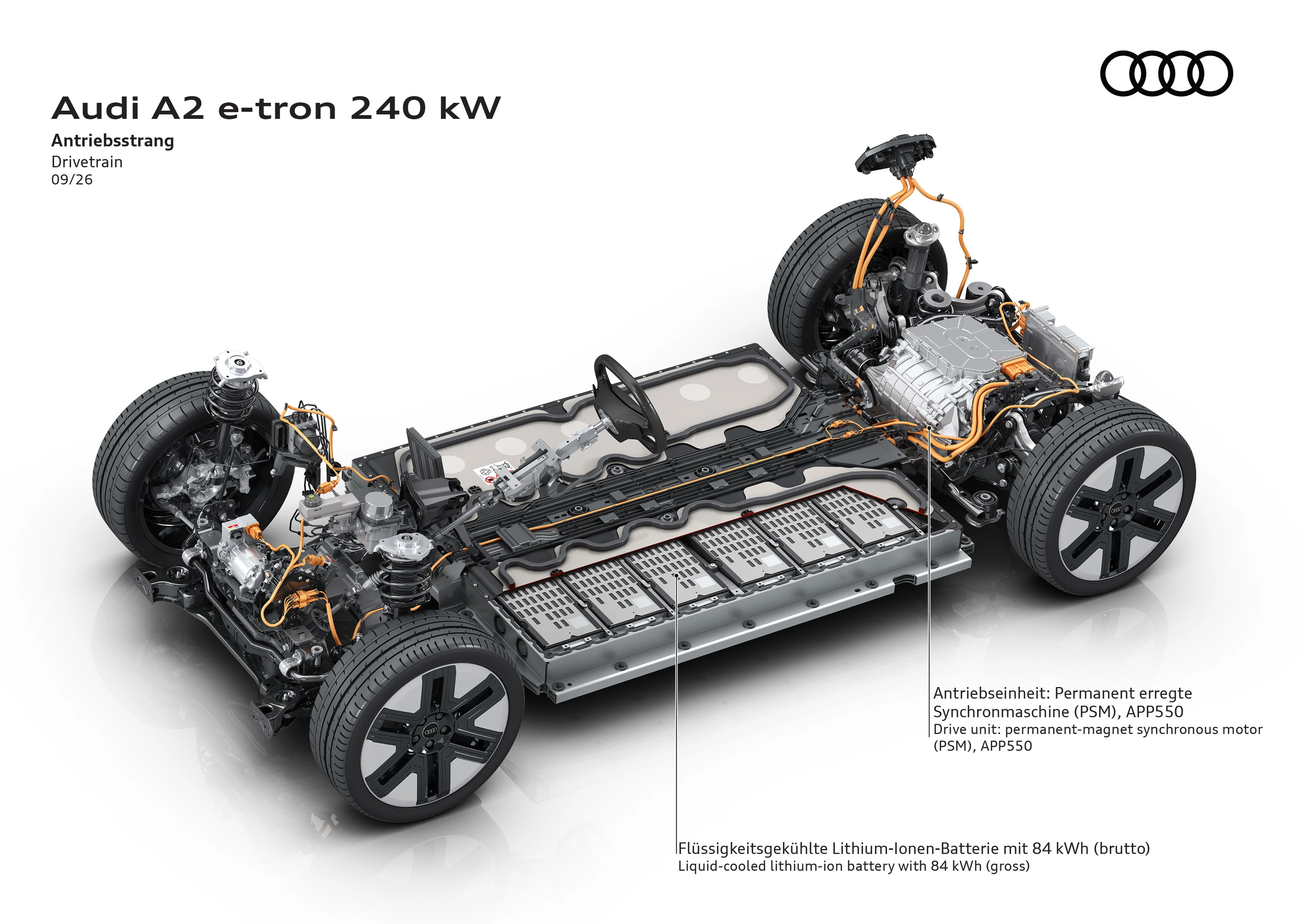
Audi A2 e-tron platform and drivetrain
Motors
Two permanently excited synchronous machines cover the four power levels:
| Drive unit | Used by | Power | Torque |
|---|---|---|---|
| APP350 | 125 kW, 140 kW, 170 kW | up to 170 kW | 350 Nm |
| APP550 | 240 kW | 240 kW | 545 Nm |
What Audi changed in the APP350
The APP350 in the A2 e-tron is a reworked version of the unit used elsewhere in the group, and Audi says it operates up to 10% more efficiently than the previous design. The changes are individually small and collectively decisive:
- Silicon-carbide semiconductors in the power electronics, cutting switching losses
- 0.2 mm motor laminations — thinner than before, reducing iron losses
- A delta-connected stator winding, shifting the motor’s efficient operating band to where the car actually spends its time
- Low-friction transmission oil
- A long 10.2:1 reduction ratio, dropping motor speed at highway cruise
The reduction ratio in particular is an efficiency-first choice. A shorter ratio would improve acceleration; the long one keeps the motor turning slowly on a motorway, which is where a long-range compact car earns or loses its WLTP figure.
Batteries
Three packs are offered, tied to power level:
| Battery | Gross | Net | Chemistry | Voltage | Configuration | Used by |
|---|---|---|---|---|---|---|
| Small | 52 kWh | 50 kWh | LFP | 333 V | 104s2p | 125 kW |
| Medium | 61 kWh | 58 kWh | LFP | 333 V | – | 140 kW |
| Large | 84 kWh | 79 kWh | NMC | 353 V | – | 170 kW, 240 kW |
LFP packs
The two smaller packs use lithium iron phosphate cells in a cell-to-pack construction: prismatic cells are bonded directly into the housing rather than assembled into intermediate modules. That raises packaging density and lowers the pack’s overall height, which is part of how Audi kept the car to 1,583 mm tall without sacrificing headroom.
LFP contains no nickel and no cobalt, is inherently durable, and — unlike nickel-based chemistries — can be charged to 100% every day without the daily charge limit normally recommended. For an entry-level car that will spend most of its life on a home wallbox, that is a genuinely practical advantage.
The LFP charging curve is also unusually flat, which means the 10–80% times of 24 and 26 minutes are more representative of real charging stops than a high peak figure would be.
NMC pack
The 84 kWh pack uses nickel manganese cobalt cells in a modular construction. It supplies the two most powerful versions, raises system voltage to 353 V and lifts DC charging to 183 kW.
Audi A2 e-tron battery and rear axle
Charging
| 52 kWh | 61 kWh | 84 kWh | |
|---|---|---|---|
| Max DC power | 100 kW | 105 kW | 183 kW |
| DC 10–80% | 24 min | 26 min | 29 min |
The charge port sits on the right rear side with a CCS2 connector for European markets. Audi also improved AC charging efficiency to 89.6%, up 1.3 percentage points, through revised cooling and control software — a gain that matters far more than it sounds, since AC charging is where most owners will put most of their energy into the car.
Bidirectional charging
The A2 e-tron can feed energy back out of the traction battery in two ways:
- Vehicle-to-Load (V2L) — powers external equipment through a socket in the luggage compartment or an adapter at the charge port
- Vehicle-to-Home (V2H) — supplies a compatible home electrical system through an Audi-recommended wallbox
V2H is offered initially in Germany, Austria and Switzerland. V2L is a separate option in some markets, including Norway.
Suspension
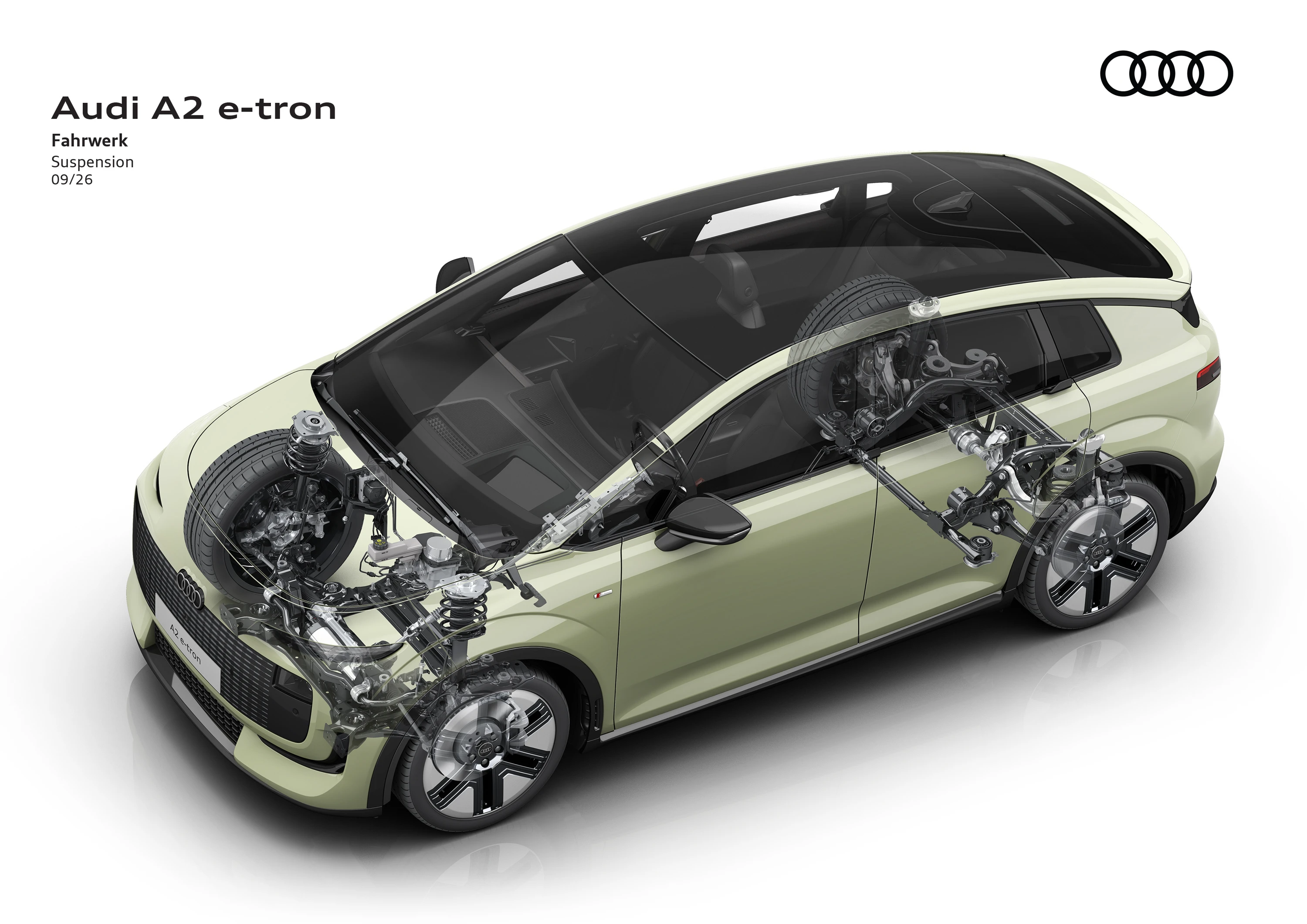
The front axle uses MacPherson struts, the rear a multi-link design — the more sophisticated rear layout, rather than the torsion beam that some MEB cars use at lower power levels.
Three suspension setups are offered:
- Comfort suspension — the standard setup, with conventional coil springs and passive dampers
- Sport suspension — lowered, and also the setup included in the efficiency package
- Suspension with damper control — adaptive damping, standard on the 240 kW version and optional elsewhere
Steering is linear as standard, with progressive steering and its variable ratio available as an option.
Driving modes and recuperation
Four driving modes are selectable: comfort, balanced, efficiency and dynamic.
Recuperation is adjustable across four levels. Paddles behind the steering wheel select D1 through D3 for progressively stronger coasting deceleration, and a B position enables one-pedal driving where the car brakes to a stop on the accelerator alone.
The A2 e-tron also has a customized electronic stability control calibration developed specifically for the rear-wheel-drive layout.
Weights and towing
| 125 kW | 140 kW | 170 kW | 240 kW | |
|---|---|---|---|---|
| Curb weight | 1,915 kg | 1,915 kg | 1,985 kg | 2,005 kg |
| Maximum total weight | 2,400 kg | 2,400 kg | 2,400 kg | 2,400 kg |
| Payload including driver | 485 kg | 485 kg | – | – |
Towing capacity is 1,600 kg braked and 750 kg unbraked, with a 75 kg maximum tow-ball weight — figures that put the A2 e-tron ahead of most compact electric cars, which frequently cannot tow at all.